
Warehouse Automation & AI Vision
.png?width=964&height=542&name=CHC_Cognex_AI_Barcode_Reading_Blog%20(2).png)
Beyond the Barcode: How AI Vision Is Becoming the Eyes of the Modern Fulfillment Center
Barcode cameras are a critical part of any automated fulfillment system. They identify products, routing totes, cartons, orders, and destinations so a warehouse control system can move each item through the right process.
Many fulfillment issues are not caused by a barcode reader simply failing to decode a label, but rather by process errors that were identified too late. An empty tote may travel through several conveyor zones before any associates realize a pick was missed. A damaged routing label may remain readable in the moment... but it'll continue to degrade until it creates an unexpected no-read condition later. Closely placed cartons may reach a sortation point without proper spacing and trigger a wrong divert decision. Each of these problems can create rework, labor waste, customer issues, and costly downstream disruption.
Traditional barcode cameras solve the traceability problem. AI vision is now helping solve the process and quality problem.
That is where Cognex SLX solutions, featuring AI-powered vision and advanced barcode-reading capabilities, can provide an important new layer of operational visibility. The value is not that AI replaces the barcode reading function. Cognex advanced decoding technology already delivers reliable read performance. The function of the AI vision is that it can inspect what is happening around the read point and help identify process conditions before they become bigger failures downstream.
What AI Actually Changes in Fulfillment Operations
A traditional barcode read point primarily answers one question: “What item, tote, or package is this?”
An AI-enabled vision point adds a different question: “Is this process condition acceptable?”
This distinction is important. In the context of the SLX readers, AI vision is not being used to magically fix a torn, folded, or unreadable barcode. Advanced decoding algorithms handle barcode readability and AI vision is used to detect conditions that may cause fulfillment problems, then notify the WMS, WCS, or controls system so the item can be routed for correction.
In that sense, the AI acts almost like a police traffic camera. If it identifies a situation in which a label or product isn't maintaining the known and set rules - it will dispatch an alert to notify staff to rectify the issue.
Tells the system what the package data is.
Tells the system what is happening around that package as it moves through the line.
Why That Matters in a Real Warehouse Environment
The benefit is not simply better reading. It is earlier detection of process errors.
In most warehouse and fulfillment environments, a read point is a critical operational junction. It determines where a product travels, what fulfillment process it requires, and what data should be associated with it. Historically, that read point has only functioned as an identification tool. With AI vision, that same point can begin acting as a process-quality checkpoint.
That matters because the cost of an error increases the longer it exists inside a system. A missing item caught immediately near a pick or induction point is easier to correct than a missing item discovered after the order has moved downstream. A label that is flagged for replacement while it is still readable is easier to address than an unexpected no-read that stops flow later. A non-singulated package detected before a divert point is less disruptive than a mis-sort that has to be traced, corrected, and reprocessed.
AI vision does not physically fix these issues. It detects when a pre-set condition has not been met, creates the appropriate signal or error code, and allows the WMS or WCS to route the problem item to a rework lane or other remediation point.
The operational value is that the issue is caught earlier, at line speed, before it becomes more expensive to correct.
AI Vision Tasks Enhance Operational Efficiency Beyond High Read Rates
Not all AI vision applications solve the same problem. Cognex AI vision capabilities are structured to scale with process complexity, throughput, and operational visibility needs.
In fulfillment environments, AI vision is increasingly being applied in four major ways.
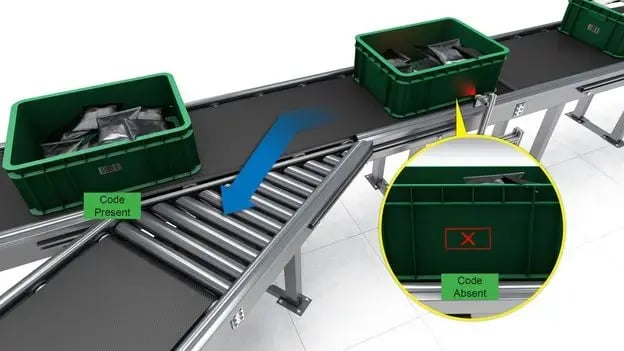
Presence & Absence Detection
Empty totes, missing items, missing barcode labels, or incomplete containers can continue through a system undetected, consuming conveyor space, divert capacity, and labor resources downstream. AI-enabled machine vision solutions can detect these conditions directly within the flow of the system and alert the WMS or WCS so the affected tote, item, or package is routed to the correct rework process.
Classification & Process Awareness
AI vision systems can classify varying package types and identify process abnormalities without extensive reprogramming. This is especially valuable for facilities managing a wide range of SKUs, packaging styles, carton sizes, totes, bags, and fulfillment profiles.
Segmentation for High-Speed Sortation
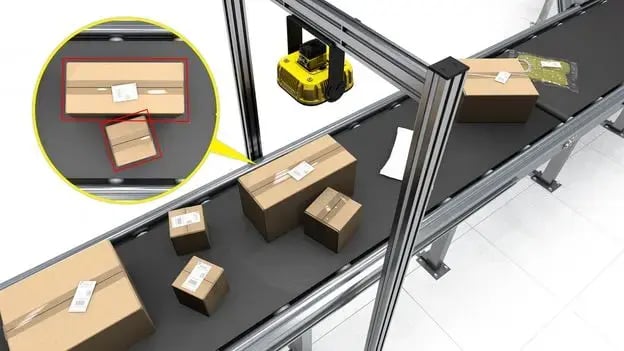
One of the most difficult challenges in high-speed fulfillment is distinguishing improperly gapped or overlapping packages at line speed. AI vision can identify when packages are not properly singulated, then notify the controls environment before the condition creates a mis-sort downstream.
Label Inspection & Proactive Label Quality
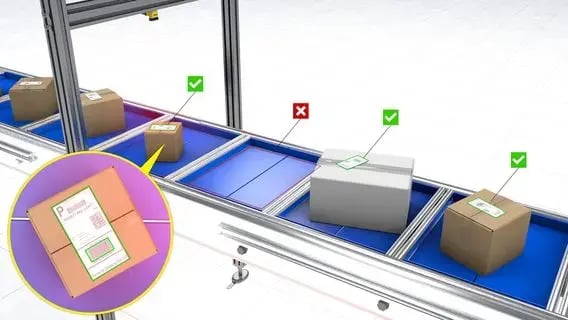
A barcode label may be readable today while still showing signs that it is becoming a problem. AI vision can inspect label condition proactively and route a tote, tray, or reusable container for relabeling before a future no-read condition appears unexpectedly during production.
A Practical Look at Cognex SLX Applications
The SLX readers are built for logistics environments where read points and inspection points are often part of the same automated flow. The right device depends on where the issue occurs, what the system needs to detect, and how the WMS or WCS should respond when a condition fails.
| Solution | Best Fit | Ideal Usage in a Fulfillment Center |
|---|---|---|
| SLX-280D |
Zone routing and tote inspection | Use where the system needs consistent barcode reading while also checking tote conditions, label presence, or routing readiness at conveyor zones. |
| SLX-290 | Item classification and barcode reading | Use where the operation needs to classify products, packages, totes, or handling profiles while maintaining code reading and process visibility. |
| SLX-3616 | Side-by-side detection and large-format top-side barcode reading | Use in high-speed sortation or large read-zone applications where side-by-side package detection, segmentation, and top-side reading are critical. |
A Practical Look at Cognex AI Vision Integration
The current perception is that implementing anything involving AI requires a highly technical deployment process. That assumption is becoming outdated.
Cognex SLX solutions are designed to be deployed and used by operations teams, not machine vision engineers. The AI model training and recognition architecture has already been developed by Cognex. When deployed in a fulfillment environment, the system only needs to be trained around the products, labels, package conditions, and process requirements unique to that facility.
This dramatically lowers the barrier to entry for AI vision integration.
Guided Deployment
Modern AI vision systems use guided setup tools and browser-based interfaces that simplify deployment and reduce commissioning time.
AI at the Edge
These systems can evaluate pre-set conditions directly within the device itself, helping decisions happen at line speed with reduced latency.
Drop-In Integration
From a controls standpoint, these devices function much like traditional readers already used throughout warehouse systems.
When a problem condition is detected, the AI vision system does not “fix” the item on its own. It identifies the failed condition, sends the signal or error code to the WMS or WCS, and the system routes that item, tote, or package to the appropriate remediation area in real time.
They integrate directly into conveyor systems, sortation equipment, WES/WMS/WCS environments, and existing control architectures. No major system redesign is required.
In many cases, facilities can retrofit AI vision directly into existing trouble zones with minimal disruption. That means an operation does not need to overhaul an entire facility to benefit from AI vision. It can start at the location where process errors, rework, or exception rates are highest.
Where AI Vision Delivers the Most Value
AI-based vision tends to provide the greatest operational impact anywhere variability, speed, and process accuracy intersect inside a fulfillment environment.
- Induction points with inconsistent labels or tote conditions
- High-speed divert and sortation systems
- Shipping verification lanes
- Returns processing
- Storage and retrieval workflows
- Quality control checkpoints
Importantly, AI vision should not be viewed as a separate system. It should be viewed "the next evolution" of barcode readers.
That means facilities can incrementally deploy AI vision where bottlenecks or exception rates are highest, rather than pursuing costly full-system overhauls. A single problem area may be the right place to start. If an induction zone is sending too many exception items downstream, or if a sortation line is experiencing frequent gapping issues, an AI vision deployment can target that exact operational pain point.
The Bottom Line
When warehouse operators hear the phrase “AI implementation,” the image that often comes to mind is a costly, complex system overhaul requiring extensive training and operational disruption.
Modern AI vision integration looks much different.
It often means deploying AI-enabled solutions that integrate much like traditional hardware already used throughout the facility. The difference is that these devices are no longer just reading barcodes. They are also interpreting process conditions, identifying abnormalities, validating operational flow, and helping the system act on problems before they become more costly downstream.
By shifting from basic rule-based inspection toward learned recognition and process intelligence, AI vision systems can reduce recirculation and manual intervention, improve throughput consistency, increase operational visibility, enable valuable process analytics, and remain quickly retrainable as warehouse operations evolve.
Most importantly, AI vision is no longer a difficult technology barrier for fulfillment operations. It is becoming a practical, scalable process-control tool.
Looking to Reduce Exceptions or Increase Process Visibility?
If mis-sorts, empty totes, missing labels, degraded tote labels, or other operational exceptions are creating bottlenecks in your fulfillment operation, outfitting your system with AI vision and advanced barcode reading are one of the most direct ways to stabilize and improve performance.
From evaluating barcode label condition to detecting process issues at line speed, Cognex's SLX readers with AI vision are quickly becoming a critical layer in modern warehouse automation strategies.
Whether it is a retrofit at a single problem zone or part of a broader automation initiative, CHC can help identify where AI vision can deliver the greatest operational impact as part of a complete turnkey material handling integration solution.
Talk to CHC About Vision Integration